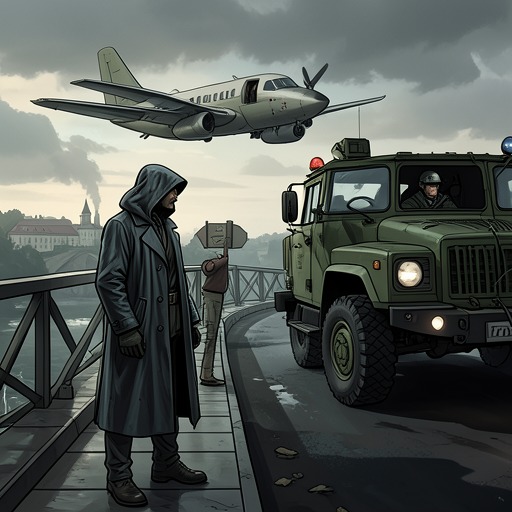
Authorization to use any necessary force
Heart of the HunterAuthorization to use any necessary force is Janina Mentz’s directive to Captain Tiger Mazibuko during the hunt for Thobela Mpayipheli. Issued because the intelligence data he carries is exceptionally sensitive to the government and its intelligence service, it removes any ambiguity about the means permitted to stop him—and, in Mazibuko’s private understanding, makes shooting him an acceptable outcome.
Background and Terms
Mentz frames the order as a response to both the value of the data and Mpayipheli’s conduct. She says he knows how seriously the authorities regard the material, has used violence, and has chosen confrontation; she characterizes him as dangerous and determined. The threat is therefore presented not only as a matter of protecting information, but also as a reason to treat the fugitive as an especially serious opponent.
The authorization is explicit: “So sensitive that you have the right to use any necessary force to stop him, Tiger. I repeat: any necessary force.” By repeating the phrase, Mentz makes the breadth of the permission unmistakable. The stated objective is to stop Mpayipheli, but the order sets no narrower limit on what force may be used to achieve it.
Operational Consequences
Mazibuko accepts the instruction with a brief acknowledgment: “I hear you.” Mentz then describes a larger deployment. She plans to request available personnel from army bases at De Aar, Kimberley and Jan Kempdorp, places Mazibuko in Kimberley so he can respond quickly, and says the police and army should watch the roads. She also intends to put the entire Rooivalk Squadron on standby there. The force authorization thus accompanies a widening effort to cover Mpayipheli’s possible routes and prepare for his next contact with the authorities.
The exchange gives the directive an immediate operational setting: Mazibuko is not merely told that force is permissible, but positioned within a mobile response backed by additional personnel and aircraft. Mentz acknowledges that there are too many possible routes to watch, making rapid response and concentrated manpower part of the plan. The order changes the pursuit from surveillance and interception into a deployment prepared for armed confrontation.
Mazibuko’s Interpretation
Later, the directive returns in Mazibuko’s thoughts as “Any necessary action, Janina Mentz had said.” He translates its official wording into a blunt personal conclusion: “In other words, shoot the fucker if you like.” The contrast between Mentz’s procedural language and Mazibuko’s coarse paraphrase exposes the lethal implication that the formal order leaves open.
That prospect appeals to him. As he considers whether the source of his hate matters so long as he can control and channel it, he looks forward to the encounter. The authorization therefore does more than establish what the operation permits: in Mazibuko’s mind, it gives his anticipated violence institutional cover. The gap between the stated aim of stopping Mpayipheli and the permission to use any necessary force is the rule’s decisive tension.